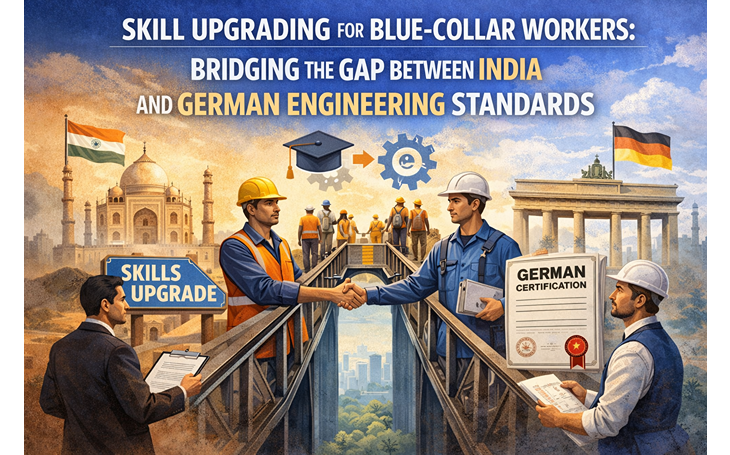
Skill Upgrading for Blue-Collar Workers: Bridging the Gap Between India and German Engineering Standards
In today’s globalized labour market, the demand for skilled blue-collar professionals has grown beyond borders. Germany, with its world-class engineering, manufacturing and industrial infrastructure, represents one of the most advanced destinations for blue-collar workers. However, the challenge lies in bridging the skill gap between India’s existing training ecosystem and the German engineering standards that define precision, safety and efficiency.
As overseas recruitment agencies increasingly deploy Indian manpower to Europe, upgrading the skills of workers has become not just an advantage but a necessity. At GILS Pvt Ltd, we believe that skill alignment is the foundation of successful manpower deployment, ensuring that both employers and workers thrive in international environments.
1. The Need for Skill Upgradation in Overseas Recruitment
India remains one of the world’s leading suppliers of skilled and semi-skilled blue-collar manpower. Workers from India are in high demand across Germany, the Middle East and other global markets for roles in construction, fabrication, manufacturing and maintenance.
However, while Indian workers are known for their strong work ethic, German employers often expect higher precision, technical literacy and compliance with DIN (Deutsches Institut für Normung) standards which govern quality, safety and efficiency in almost every engineering domain.
This gap, though not insurmountable, needs structured attention. Without adequate preparation, even skilled Indian workers can struggle to meet expectations in Germany’s highly systemized industrial environment.
That is where skill upgrading becomes the bridge between the strong foundation of Indian workmanship and the advanced demands of European engineering.
2. Understanding the German Engineering Mindset
Germany’s industrial success is rooted in its dual education system, where technical training is integrated with practical apprenticeships. This approach produces workers who are not just technically competent but also deeply aware of safety, process discipline and environmental responsibility.
Indian workers deployed through overseas recruitment consultants often come with strong hands-on experience but limited exposure to such structured training systems. German employers value:
◾ Precision and quality assurance at every production stage.
◾ Technical documentation and process traceability.
◾ Adherence to international safety norms and certifications.
◾ Continuous learning and on-the-job improvement.
Bridging these expectations requires targeted upskilling programs before deployment, something that leading overseas recruitment agencies like GILS Pvt Ltd actively facilitate.
3. Key Skill Areas Where Upgradation Is Essential
To align with German engineering standards, blue-collar workers from India should focus on upgrading skills in the following areas:
1. Technical Precision and Tool Handling
German industries expect a high level of precision in mechanical and electrical work. Workers should be trained in:
◾ Reading and interpreting technical blueprints.
◾ Calibrating instruments and measuring accurately.
◾ Using advanced machinery and digital tools.
2. Quality and Process Control
Quality control is deeply embedded in the German production system. Workers must understand:
◾ Quality assurance and quality control techniques.
◾ Documentation and reporting standards.
◾ ISO and DIN compliance requirements.
3. Safety and Environmental Compliance
Safety is not optional in Germany. Workers must be fluent in:
◾ Occupational health and safety protocols.
◾ Use of PPE, fire safety and emergency procedures.
◾ Waste management and eco-friendly operations.
4. Digital Literacy and Automation
Industry 4.0 is transforming manufacturing worldwide. Skills in automation, IoT-enabled devices and computer-controlled systems are increasingly required. Workers must understand basic digital interfaces, sensors and programmable tools.
5. Language and Cultural Orientation
Basic German language training and cultural awareness are critical for effective communication and workplace harmony. Understanding cultural nuances enhances productivity and helps workers adapt faster.
4. The Role of Indian Training Institutions and Recruitment Agencies
India has thousands of Industrial Training Institutes and skill-development centres producing technically trained workers. However, only a fraction of these are aligned with international employment service requirements.
Recruitment agencies like GILS Pvt Ltd play a crucial role in bridging that alignment through:
◾ Pre-deployment training programs tailored for specific countries.
◾ Language and cultural orientation modules.
◾ Partnerships with certified technical training centres that follow international standards.
◾ Collaboration with German employers to understand evolving skill demands.
By upgrading training quality before deployment, Indian agencies can ensure seamless manpower integration abroad and minimize adaptation challenges.
5. How GILS Pvt Ltd Prepares Workers for the Global Market
At GILS Pvt Ltd, we go beyond traditional recruitment. We function as a complete workforce solutions partner, ensuring that every worker deployed for jobs abroad meets or exceeds employer expectations.
Our approach includes:
◾ Skill mapping to evaluate each worker’s competencies.
◾ Gap identification against German and Gulf standards.
◾ Customized hands-on training in collaboration with technical institutes.
◾ Compliance readiness covering documentation, contracts and labour regulations.
◾ Post-deployment support to monitor adaptation and performance.
Through these steps, we create a continuous improvement cycle that enables ongoing upskilling and ensures consistent success for both employers and workers.
6. Lessons from Germany for the Indian Workforce
Germany’s emphasis on vocational excellence offers valuable lessons for India’s growing labour market. The future of overseas recruitment services lies in integrating similar models where training, assessment and certification precede deployment.
For example:
◾ Dual-learning frameworks combining theory with practical experience.
◾ Public-private partnerships aligning training with global demand.
◾ Accredited skill testing before worker mobilization.
Such structured training will elevate India’s standing in the global manpower market, ensuring Indian blue-collar workers remain among the most sought-after worldwide.
7. The Global Payoff: Better Jobs and Better Productivity
When workers are better trained, everyone benefits:
◾ Employers gain reliable and high-performing manpower.
◾ Recruitment agencies build stronger and longer-term client relationships.
◾ Workers enjoy safer, higher-paying and more stable overseas jobs.
In the long term, skill upgrading transforms the reputation of Indian labour from cost-effective to world-class, opening new markets not only in Germany but also across Europe and the Gulf.
Conclusion
The road to global workforce excellence runs through skill upgrading and alignment with international standards. For blue-collar workers aiming to succeed in Germany or other advanced markets, mastering new technologies, safety norms and quality benchmarks is the key to sustainable success.
At GILS Pvt Ltd, we are committed to building this bridge between India’s skilled workforce and the world’s most demanding employers. Through targeted upskilling, ethical recruitment and comprehensive manpower deployment, we empower workers to transform not only their careers but also the global industries they serve.
Contact
GILS Pvt Ltd
today to learn how we prepare and deploy India’s finest blue-collar talent for international excellence.
Check us out on
LinkedIn
.