
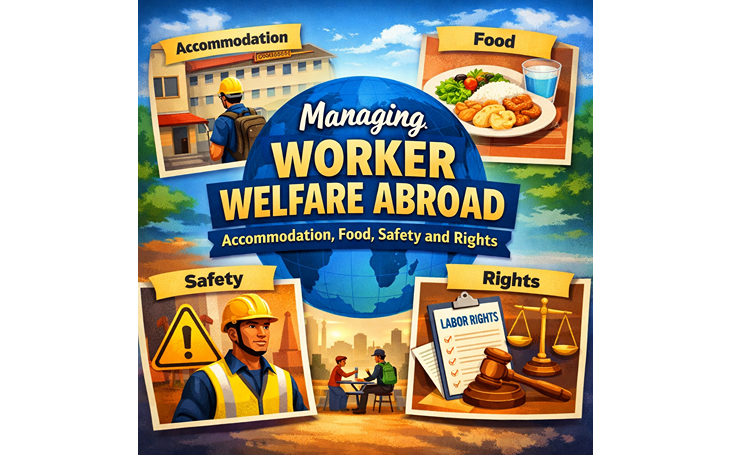
Managing Worker Welfare Abroad: Accommodation, Food, Safety and Rights
When workers travel overseas, they enter a new world. They live in unfamiliar environments, adjust to new cultures and rely heavily on employers for basic needs. Welfare is not a benefit. It is a responsibility. Proper accommodation, safe food arrangements, protective work conditions and respect for worker rights are essential for a stable international workforce. When these are handled correctly, productivity increases and turnover drops. When ignored, even well-trained teams fail.
A strong recruitment partner helps ensure that worker welfare is never negotiable.
Why Worker Welfare Matters
Overseas projects demand long hours, tight timelines and coordinated teams. Workers can only perform when they are mentally and physically secure. Accommodation, meals and health access are not luxuries, but the foundation of worker wellbeing. If a worker worries about water quality, overcrowded rooms or unsafe transport, performance will fall. Welfare is a practical investment for employers, not a moral gesture.
Countries like Saudi Arabia, Qatar and UAE have strict rules on worker housing and health arrangements. Employers must meet local standards or face penalties. Companies that treat these requirements casually risk losing contracts and damaging their reputation.
Accommodation: Where Workers Rest Shapes Their Work
Living conditions directly affect morale and energy. Proper accommodation includes basic privacy, sanitation and climate control. Workers should have clean rooms, functioning cooling or heating systems and access to washrooms. Shared spaces must not be overcrowded. Good housing reduces illnesses and improves attendance.
Transport is also part of accommodation. Workers should have safe vehicles, fixed pickup schedules and access to their worksites without stress. When transport is predictable, workers arrive focused instead of exhausted.
Food and Nutrition: More Than Daily Meals
Many workers travel abroad for the first time and cannot adapt easily to foreign food. Providing balanced, culturally appropriate meals prevents health issues and fatigue. Poor nutrition can lead to low productivity, dehydration, or slow recovery from physical work.
The best employers keep kitchens hygienic, follow food safety rules and offer natural drinking water. Rotational menus and proper seasoning matter. The difference between a basic meal and a thoughtful one can be seen in worker attitude and energy.
Workplace Safety: The Most Critical Welfare Element
Safety is not just protective gear. It is a complete system. From the induction briefing to on-site supervision, every worker should know how to protect themselves. Employers must provide helmets, gloves, shoes and harnesses where needed. They must monitor equipment regularly and train workers on hazard awareness.
Safety also includes reporting. Workers must feel comfortable raising issues without fear. In many countries, authorities carry out site audits. Compliance is not optional. A single accident can damage lives and halt entire projects.
Worker Rights: Dignity and Fair Treatment
Welfare is incomplete without respect. Workers must know their rights before deployment. Their employment contract should explain wages, overtime, rest days and living conditions. Employers must honour these terms. Fair wages must be paid on time and in traceable form. Workers should have access to communication, health checks and grievance channels.
Open communication between companies and workers reduces misunderstandings. Agencies that properly explain expectations create teams that stay longer and perform better.
How GILS Verifies Welfare and Compliance
Recruitment should not end after a worker boards a plane. GILS helps evaluate employer standards before candidates are deployed. Workers are briefed about living conditions, work culture and site rules. Documentation is checked to ensure the offer matches the job. When needed,
GILS Pvt Ltd
communicates with clients to resolve issues or clarify terms.
For large deployments, welfare verification becomes a continuous practice. Accommodation photographs, employer audits and feedback from existing employees help identify gaps. This helps prevent disputes, worker dissatisfaction and unexpected attrition.
Final Thoughts
Worker welfare abroad affects performance, stability and reputation. Employers that invest in accommodation, nutrition, safety and rights build strong teams that stay longer and deliver better results. Agencies play a key role in guiding candidates and verifying compliance before they ever reach the worksite.
Strong recruitment is not only about hiring. It is about creating conditions in which workers can succeed.
Check us out on
LinkedIn
.