
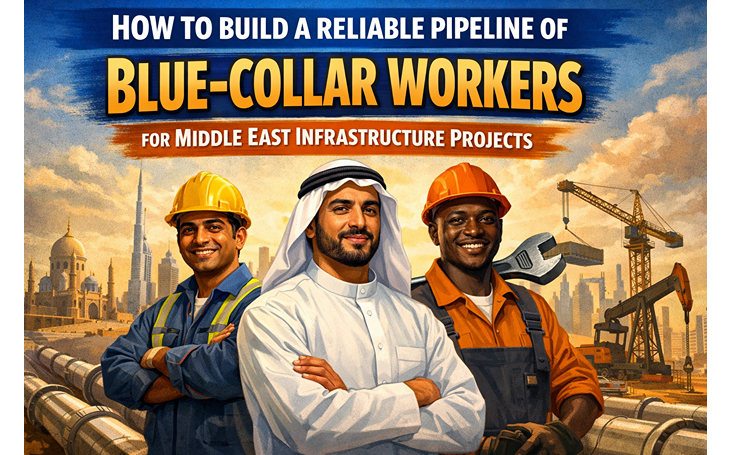
How to Build a Reliable Pipeline of Blue-Collar Workers for Middle East Infrastructure Projects
The Middle East continues to stand as a global hub for mega-infrastructure development, massive airport expansions, new cities, industrial corridors, renewable energy plants, and smart-city projects are rising across Saudi Arabia, the UAE, Qatar, and Oman.
Behind every successful project lies a critical success factor: a steady, reliable pipeline of skilled blue-collar workers.
However, establishing that pipeline isn’t easy. Project timelines are tight, visa and compliance rules vary by country, and the demand for specific trades can shift overnight. In such a dynamic market, overseas recruitment services play a decisive role in connecting the right manpower with the right opportunity, efficiently, legally, and ethically.
In this article, we explore practical strategies to help contractors, developers, and recruiters build and sustain a dependable blue-collar workforce supply chain for Middle East infrastructure projects.
1. Understand Project-Specific Skill Demands Early
Every infrastructure project has its own labour DNA. A metro rail system, for instance, will demand welders, electricians, and safety officers, while an oil & gas plant may prioritize riggers, fabricators, and heavy-equipment operators.
The first step in building a recruitment pipeline is forecasting manpower needs well before mobilization begins. Collaborate with project planners and engineers to list required trades, certifications, and quantities. This proactive manpower planning ensures your overseas recruitment consultants have sufficient lead time to identify, screen, and mobilize the right candidates.
2. Partner with Trusted Overseas Recruitment Agencies
The Gulf market’s scale and complexity make it impossible to rely on ad-hoc hiring. Companies must align with reliable overseas recruitment agencies that have established sourcing networks and on-ground experience in manpower deployment.
A strong agency will:
◾ Maintain verified worker databases across multiple trades.
◾ Conduct skill tests and medical screenings.
◾ Handle visa documentation and labour approvals.
◾ Ensure ethical recruitment compliant with local and international laws.
At GILS Pvt Ltd, for example, our teams combine over a decade of experience in overseas recruitment and international employment services, delivering trained manpower across sectors such as construction, oil & gas, manufacturing, and facilities management.
The right partnership transforms recruitment from a reactive process into a continuous pipeline.
3. Build a Pre-Qualified Talent Pool
Rather than beginning every hiring cycle from zero, smart companies maintain an active database of pre-qualified candidates, workers who have been screened, trained, and are ready for deployment.
This approach has multiple advantages:
◾ Faster mobilization when new projects start.
◾ Better retention through recurring placements.
◾ Reduced costs on repetitive assessments.
Using digital tools or a simple CRM, overseas recruitment consultants can categorize candidates by skill, certification, location, and readiness status. When a client requires, say, 200 scaffolding workers for a project in Dubai, you already know exactly who’s fit for the job.
4. Invest in Training and Upskilling
The Middle East’s blue-collar workforce expectations are evolving, clients increasingly demand certified, safety-conscious, and tech-savvy workers. Establishing a training pipeline back home in India or South Asia is a game-changer.
Setting up or partnering with vocational training centers allows you to:
◾ Align skills with international project standards.
◾ Offer language and cultural orientation programs.
◾ Prepare workers for specific roles like HVAC technicians, pipe fitters, or machine operators.
This not only improves placement rates but also enhances your brand’s credibility among employers seeking overseas recruitment services they can trust.
5. Streamline Documentation and Compliance
Compliance can make or break a deployment schedule. Every country, Saudi Arabia, UAE, Qatar, Kuwait, has distinct visa categories, labour contracts, and medical prerequisites. Maintaining a standardized documentation process minimizes errors and delays.
Implement a workflow that covers:
◾ Employment offer verification.
◾ Medical fitness and police clearance.
◾ Visa stamping, emigration clearance, and travel logistics.
Professional abroad job consultancy firms use dedicated compliance teams to ensure all documentation aligns with both Indian and Gulf labour regulations.
6. Leverage Digital Platforms for Recruitment
Today, technology plays a central role in overseas jobs and manpower deployment. Online job boards, applicant-tracking systems, and mobile apps allow recruiters to reach larger audiences and screen candidates remotely.
Digitalization helps in:
◾ Advertising blue-collar jobs in Dubai and other Gulf markets.
◾ Conducting video interviews and virtual trade tests.
◾ Maintaining transparent communication with candidates and clients.
By integrating data analytics, recruiters can even predict upcoming workforce shortages and plan recruitment drives proactively.
7. Focus on Worker Welfare and Retention
A recruitment pipeline isn’t just about supply, it’s also about sustainability. Retaining skilled manpower is vital for long-term project success.
Employers and recruitment partners should collaborate to ensure:
◾ Safe accommodation and fair working conditions.
◾ Timely salary payments and grievance redressal.
◾ Health insurance and return-ticket policies.
When workers feel valued and supported, they become your best brand ambassadors, encouraging others to seek jobs abroad through your network.
8. Measure and Improve Continuously
Finally, treat your workforce pipeline like a living system. Track metrics such as mobilization time, deployment cost per worker, attrition rate, and client satisfaction. Use these insights to continuously refine sourcing strategies and training modules.
The Middle East’s infrastructure boom is long-term, but only companies that treat overseas recruitment as a strategic process, not a transactional one, will thrive in the years ahead.
Conclusion
Building a reliable pipeline of blue-collar workers for Middle East projects demands planning, partnership, and professionalism. From forecasting demand and training workers to ensuring compliance and retention, every step strengthens your manpower ecosystem.
As one of India’s leading overseas recruitment agencies, GILS Pvt Ltd specializes in delivering end-to-end international employment services, connecting skilled workers with world-class infrastructure projects across the Gulf.
If your organization seeks a partner to manage large-scale manpower deployment with speed, ethics, and efficiency,
Contact
GILS Pvt Ltd
today to begin building your global workforce advantage.
Check us out on
LinkedIn.