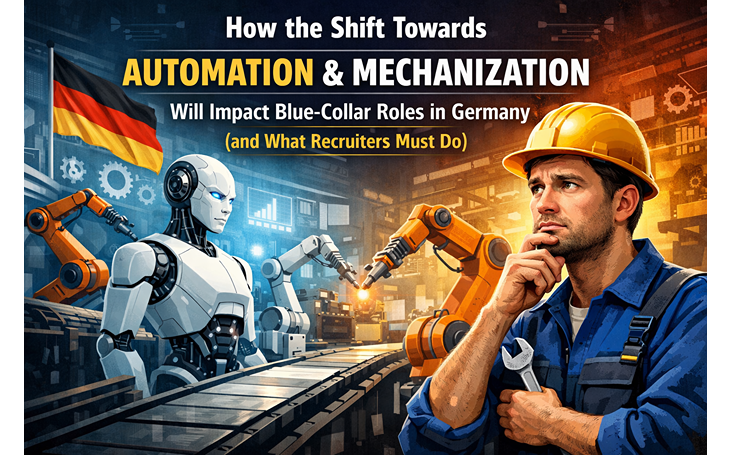
How the Shift Towards Automation and Mechanization Will Impact Blue-Collar Roles in Germany (and What Recruiters Must Do)
The industrial landscape in Germany is undergoing a significant transformation. As automation, robotics, Industry 4.0 and digitalisation reshape manufacturing, logistics and infrastructure, traditional blue-collar roles are no longer immune from disruption. For employers, overseas recruitment agencies and workers alike, understanding how this shift affects German blue-collar jobs is essential. For international recruiters specialising in overseas recruitment services, this presents both a challenge and an opportunity.
In this article we explore how mechanisation and automation are changing the blue-collar workforce in Germany, what this means for manpower deployment and recruitment strategies, and how agencies like GILS Pvt Ltd can adapt.
1. What’s Changing in the German Blue-Collar Landscape
Germany’s economy has long been anchored by strong manufacturing, automotive, machinery and logistics sectors. However, a number of key trends are redefining blue-collar roles:
◾ Automation and robotics
German firms are increasingly automating labour-intensive tasks. For example, small and medium enterprises are replacing physically strenuous machine-operation jobs with robotic assistants. This means some routine manual tasks that earlier required many workers will now require fewer, but higher-skilled operators.
◾ Digitalisation and smart factory systems
As German manufacturing adopts Work 4.0 and Industry 4.0 concepts, blue-collar workers are increasingly interacting with automated systems, sensors, digital controls and integrated data flows. Tasks like quality inspection, material handling or machine supervision are being augmented or replaced by digital tools.
◾ Skills shift and job reshaping
While blue-collar jobs are not disappearing entirely, their content is changing. Some routine mid-skill roles are at high risk of automation. Meanwhile, jobs demanding technical maintenance, digital monitoring and adaptive skills are increasing.
◾ Demographic pressure
Germany is facing a shrinking working-age population and a shortage of younger entrants into trades. At the same time automation is seen as a way to offset labour scarcity.
2. Why This Matters for Overseas Recruitment and Workforce Deployment
The implications for recruiters and overseas deployment are profound:
A. Evolving role definitions
Workers once hired for purely manual, physically demanding tasks may find that by 2030 they are expected to handle equipment, monitor digital systems or perform predictive maintenance. Recruiters must therefore source talent not just for existing job descriptions but for future-ready roles.
B. Higher skill threshold for deployment
The augmentation of blue-collar work with automation means employers will increasingly prioritise candidates who can operate robotics, interpret machine data, perform fault diagnosis or interface with digital systems. This raises the bar for overseas recruitment consultants, as selection, training and orientation must reflect this shift.
C. Retention and long-term value
If a deployed worker lacks the skills to adapt to mechanised methods, their job may become redundant faster or the employer may replace them. For manpower deployment to be sustainable, agencies must prepare workers for change, boosting retention and reducing churn.
D. Brand and service differentiation
For overseas recruitment agencies competing in crowded markets, being able to supply automation-aware blue-collar talent for Germany becomes a differentiator. Companies want workforce providers who understand the modern German industrial context, not just traditional labour supply.
3. What Recruiters Must Do to Adapt
Here are actionable strategies for recruitment agencies like GILS Pvt Ltd and their employer partners:
i. Update selection criteria and training programmes
Recruiters must redefine blue-collar candidate profiles to include digital literacy, mechanical competency, basic data interpretation skills and flexibility. Training centres need to upgrade modules to cover robotics basics, PLC familiarity, sensor-based maintenance and process monitoring.
ii. Pre-deployment upskilling
Before sending workers abroad, invest in training that aligns with Germany’s smart manufacturing environment. This might include:
◾ Hands-on simulation of automated production lines.
◾ Exposure to digital logging, quality systems and fault-analysis tasks.
◾ Language and cultural orientation for German industrial settings, especially for overseas jobs in Germany.
iii. Close employer-agency collaboration
Agencies must work closely with employer clients in Germany to understand upcoming automation initiatives and skill requirements. The recruitment consultant becomes a partner in workforce planning, not only in filling seats. This enables better forecasting of roles and candidate preparation.
iv. Develop lifelong adaptability and reskilling pathways
Since technology will continue to evolve, enabling workers to upskill on-site, access certifications and transition into automated roles is vital. Agencies offering such post-deployment support will gain trust and long-term relationships.
v. Emphasise worker welfare and change management
Automation can be unsettling for workers used to traditional tasks. Effective deployment includes change-management orientation, explaining how mechanisation affects roles, ensuring workers are engaged and motivating them to work alongside machines rather than fearing replacement.
4. Opportunities in Disruption
While automation presents risks, it also opens up new avenues:
◾ Demand for technicians who maintain, calibrate and programme automated machines is increasing.
◾ Hybrid roles combining physical tasks with digital monitoring will grow.
◾ Germany’s skills shortage means well-prepared overseas workers have an edge, and blue-collar vacancies remain high despite automation.
◾ Recruiters who pivot quickly will be able to supply talent for the next generation blue-collar market, offering more value.
5. The GILS Pvt Ltd Approach
At GILS Pvt Ltd, we recognise the trajectory of blue-collar work in Germany and are evolving our model accordingly. Our approach includes:
◾ Skill alignment by evaluating recruits not just for current tasks but for their capacity to work in automated environments.
◾ Training partnerships with technical institutes to deliver modules on robotics, digital systems and Industry 4.0 readiness.
◾ Employer integration by working with German clients to understand their automation roadmaps so we can source appropriately.
◾ Worker preparedness through orientation on mechanised tasks, digital interfaces, change management and workplace adaptation.
◾ Long-term support to ensure workers are deployed into roles where mechanisation elevates them, rather than displaces them, thereby reducing attrition and building loyalty.
Conclusion
The shift towards automation and mechanisation in Germany’s blue-collar sectors is already underway. For overseas recruitment services, manpower deployment and employers sourcing talent from abroad, adapting to this new reality is crucial. Instead of simply filling roles, the focus must shift to sourcing and preparing future-ready workers who can thrive in increasingly automated and digitised environments.
By embracing upskilling, strong employer-agency collaboration and worker-centric deployment strategies, recruitment firms like GILS Pvt Ltd provide true value in today’s rapidly changing blue-collar labour market. If you are looking for a partner that understands Germany’s evolving industrial demands and can supply candidates for the blue-collar jobs of tomorrow, contact GILS Pvt Ltd today.
Check us out on LinkedIn.