

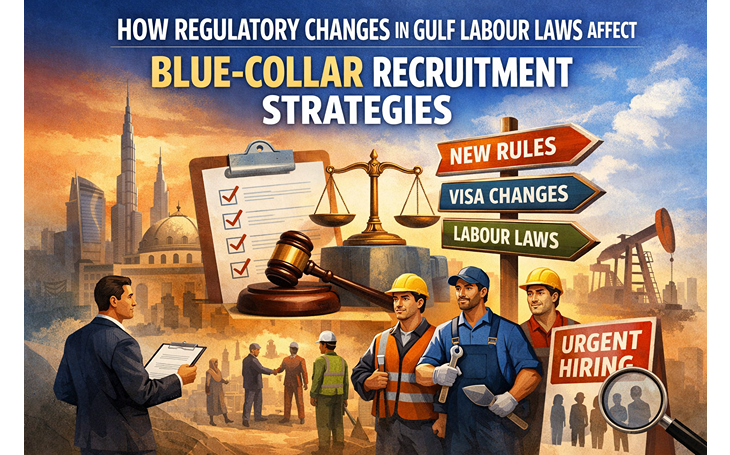
How Regulatory Changes in Gulf Labour Laws Affect Blue-Collar Recruitment Strategies
The Gulf region has long been a major destination for blue-collar recruitment out of India and other labour-sending countries. With large-scale infrastructure, construction, manufacturing and energy projects underway, employers and recruiters rely heavily on overseas manpower deployment. Yet in recent years, significant regulatory changes in Gulf labour laws have reshaped the rules of engagement, meaning companies and overseas recruitment agencies must adjust their strategies accordingly.
In this article, we outline key labour-law developments in the Gulf, examine their impact on overseas recruitment services and blue-collar jobs in Dubai and beyond, and propose strategic responses for staffing agencies and employers to remain compliant and competitive.
1. Key Regulatory Trends in Gulf Labour Markets
A. Abolition or Reform of the “Kafala” (Sponsorship) System
In several Gulf states, reforms have been introduced that remove or reduce the employer’s exclusive control over the migrant worker’s mobility. For instance, in Qatar the reforms allow foreign workers to change jobs without requiring a “No Objection Certificate” (NOC) from the employer.
This is a major shift for blue-collar recruitment, affecting how contracts and job offers must be structured.
B. Wage Protection and Transparent Pay Systems
Gulf countries are implementing or strengthening systems where the employer must pay salaries via authorised bank transfers and maintain full records. Example: the “Wage Protection System” (WPS) in the UAE and Qatar.
This raises the standard of compliance that recruiters and employers must adhere to.
C. Minimum Wage, Workers’ Rights and Documentation
Some states have introduced non-discriminatory minimum wages for all workers, regardless of nationality. Qatar’s reforms introduced such a minimum wage plus allowances.
Also, contracts must often be issued in multiple languages, and worker welfare standards such as housing, transport and safety are increasingly regulated.
D. Labour Mobility, Exit and Entry Rights and Digitalisation
Several Gulf states are reforming exit permit rules, job-change rights and digitalising contract registration. For example, employers’ sponsorship control over exit and re-entry visas is being reduced.
This means recruitment strategy needs to adapt to greater worker choice and mobility.
2. Implications for Blue-Collar Recruitment Strategies
These regulatory shifts have direct and indirect consequences for both employers and recruitment agencies specialising in overseas talent, particularly for blue-collar positions.
Compliance Becomes a Key Differentiator
With higher minimum standards and stronger enforcement, agencies that cannot demonstrate ethical and transparent processes risk being excluded or penalised. For example, those offering jobs abroad without proper contractual clarity may find mobilisation blocked or reversed.
Contract Design and Offer Letters Must Be Precise
Recruiters must ensure job contracts match exactly the roles, wages and allowances promised during recruitment. Given the new rights of workers to switch jobs or challenge employers, any mismatch could lead to claims, fines or reputational damage.
Recruitment Cost and Pricing Models May Shift
As employer responsibility increases for wages, welfare, accommodation and digital records, costs may rise. Recruitment agencies and employers must build these costs into their business model. Labour providers who fail to meet the new standards may struggle to remain competitive.
Candidate Screening and Training Gains Importance
Given stricter compliance requirements in language, safety and documentation, recruiters who supply deployment-ready candidates hold a clear advantage. As Gulf employers become more selective, agencies offering pre-screening and structured training for overseas workers will perform better.
Retention and Mobility Management Become Strategic
With workers gaining more flexibility in job changes and exit or entry rights, retention of blue-collar staff becomes more challenging. Recruitment strategy must include post-deployment support, welfare monitoring and retention planning to reduce turnover and risk.
Branding and Ethical Reputation Matter More
Employers and states are under global scrutiny for migrant labour practices. Recruitment firms that emphasise ethical overseas recruitment, transparent documentation and worker welfare can build stronger brand trust in both sending and receiving markets.
3. Practical Strategy Adjustments for Agencies and Employers
1. Audit and Update Contracts
Ensure employment contracts, visas, job roles and wages match exactly what is communicated during recruitment. Discrepancies may lead to non-compliance or worker claims.
2. Invest in Pre-Employment Compliance and Training
Train candidates on contractual rights, housing standards, safety norms and mobility rights such as job change or exit. This prepares them for the evolving Gulf labour environment and reduces operational risk.
3. Build Agency Employer Partnerships with a Compliance Focus
Recruitment agencies must work closely with employers to map out costs of accommodation, transport, welfare, wage protection systems and documentation. This should become an integral part of the manpower deployment strategy.
4. Monitor Worker Welfare and Mobility
After deployment, tracking worker satisfaction, salary payment, accommodation standards and job mobility patterns is essential. Use digital tracking tools or partner with local service providers to monitor risk and retain workforce stability.
5. Transparent Pricing and Ethical Branding
Be upfront with candidates about fees, roles, wages and working conditions. Recruitment agencies should adopt fair cost models and avoid hidden recruiter fees. For employers, partnering with ethical agencies signals compliance and quality.
6. Stay Updated on Regulatory Changes by Country
Gulf labour laws are evolving, including Qatar’s reform in 2020 removing NOC requirements for job change and the UAE’s updated labour law reforms. Monitoring country-specific changes ensures workforce deployment remains valid and compliant.
4. Role of GILS Pvt Ltd in Navigating the New Regime
At GILS Pvt Ltd, we recognise the growing importance of compliance, transparency and worker mobility in the Gulf region. Our overseas recruitment services for blue-collar jobs across the Gulf and Europe are built around:
◾ Full contract audit and compliance checks for every deployment.
◾ Pre-deployment orientation covering worker rights, safety, contract literacy and Gulf country regulations.
◾ Partnerships with licensed recruitment agencies, local service providers and employer clients in the Gulf who adhere to updated labour standards.
◾ Post-deployment welfare monitoring and retention support to meet employers’ manpower stability needs.
By doing so, we help employers meet evolving regulatory expectations while providing transparent and ethical pathways for Indian workers seeking jobs abroad.
Conclusion
The Gulf labour market is undergoing a transformation. Reforms around mobility, wages, worker rights and digital oversight are now embedded in standard business operations. For recruiters and employers handling blue-collar manpower deployment, these changes are central to long-term strategy.
By aligning recruitment models with ethical, transparent and compliant practices, agencies specialising in overseas recruitment services and abroad job consultancy can thrive in a more regulated landscape. For employers seeking reliable blue-collar workers for blue-collar jobs in Dubai, Saudi Arabia or elsewhere in the Middle East, partnering with recruitment firms that understand this regulatory shift becomes a strategic advantage.
For any organisation looking for reliable, compliant and future-focused overseas recruitment partners, GILS Pvt Ltd is ready to support you in navigating these new labour law realities, ensuring successful manpower deployment, minimal risk and enhanced long-term workforce performance.
Contact
GILS Pvt Ltd
to learn more about how we can partner in compliant and strategic global workforce sourcing.
Check us out on
LinkedIn
.