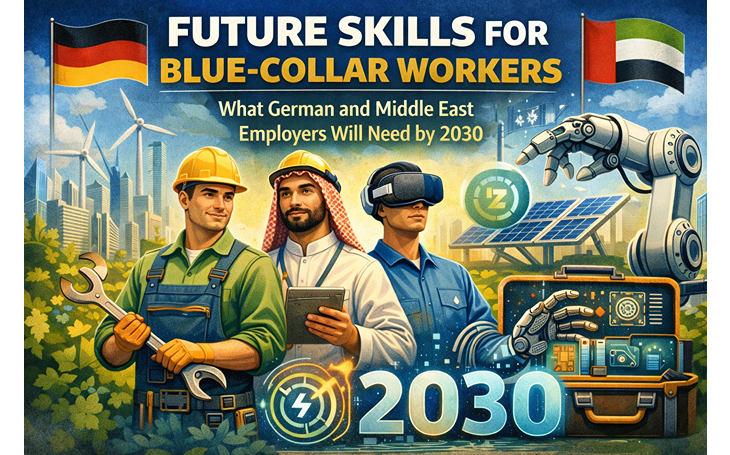
Future Skills for Blue-Collar Workers: What German and Middle East Employers Will Need by 2030
The global workforce landscape is evolving faster than ever. With automation, digitization, and sustainability reshaping industries, the demand for blue-collar workers is entering a new era. Both Germany and the Middle East - two of the largest destinations for Indian and South Asian talent - are undergoing industrial transformations that will redefine the skills employers seek by 2030.
For overseas recruitment agencies and employers alike, understanding these upcoming shifts is vital. The focus is no longer only on availability of manpower but on skill adaptability, cross-functional expertise, and technological readiness.
At GILS Pvt Ltd, a leader in overseas recruitment services, we help employers anticipate these future skill demands and prepare blue-collar workers for a world where efficiency, safety, and technology are intertwined.
1. The Changing Face of Blue-Collar Work in Global Economies
Historically, blue-collar jobs were defined by physical labor - construction, fabrication, maintenance, or logistics. By 2030, that definition will expand dramatically. The next generation of blue-collar workers will operate in hybrid environments where manual skills meet digital literacy.
In both Germany and the Gulf, three forces are driving this shift:
◾ Automation and Industry 4.0, integrating robotics, IoT, and smart tools.
◾ Sustainability mandates, especially in construction and energy.
◾ Labor market pressures, pushing employers to hire multi-skilled, adaptable workers.
These transformations demand a workforce that is technically trained, safety-oriented, and digitally competent, ensuring long-term employability in an increasingly competitive global job market.
2. Skills German Employers Will Prioritize by 2030
Germany, with its focus on high-precision manufacturing and clean technology, is redefining labor expectations. Its blue-collar sectors are moving from traditional craftsmanship to smart production powered by automation and sustainability.
1. Mechatronics and Technical Maintenance
Factories in Germany are integrating robotics and automated systems at an unprecedented rate. Workers who can troubleshoot, calibrate, and maintain these systems will be in high demand.
Future-ready candidates should understand mechanical systems alongside basic programming and diagnostic tools.
2. Green Construction and Energy Efficiency
Germany’s “Energiewende” (energy transition) is creating a surge in demand for workers trained in:
◾ Solar and wind power installation.
◾ Green building construction.
◾ Smart HVAC systems.
Recruitment agencies offering international employment services must therefore align worker training with sustainability-driven skill sets.
3. Precision Welding and Metal Fabrication
While automation is growing, skilled welders and fabricators remain indispensable in German automotive, shipbuilding, and industrial sectors. Workers familiar with CNC machinery and automated welding tools will be prioritized.
4. Logistics and Warehouse Automation
With Germany at the heart of Europe’s logistics network, demand for forklift operators, supply chain coordinators, and warehouse technicians trained in digital inventory systems is rising sharply.
5. Safety and Compliance Knowledge
Germany’s strict safety and labor regulations will continue to shape recruitment. Workers trained in European labor standards, documentation protocols, and equipment compliance will stand out.
In summary, German blue-collar jobs by 2030 will increasingly reward those who combine traditional expertise with smart technology awareness and adherence to sustainability standards.
3. Future Skill Demands in the Middle East
Across the Middle East, rapid urbanization, mega-projects, and economic diversification under national visions are reshaping labor markets. Employers will seek blue-collar workers who can contribute to smarter, more sustainable infrastructure development.
1. Digital Construction and Smart Infrastructure
Projects such as NEOM in Saudi Arabia and Expo City Dubai demand workers who understand BIM (Building Information Modelling), automated surveying, and IoT-enabled construction equipment.
Overseas recruitment consultants must therefore prioritize digital literacy even among traditional construction roles.
2. Renewable Energy and Green Mobility
The Middle East is investing heavily in renewable energy. By 2030, technicians skilled in solar farm maintenance, hydrogen energy systems, and electric vehicle charging infrastructure will be in demand.
3. Facility Management and Smart Building Maintenance
With the rise of smart cities, employers need technicians who can maintain automated lighting, HVAC, and energy systems. Workers trained in predictive maintenance using digital sensors will have a competitive edge.
4. Health and Safety Compliance
Global standards are shaping the region’s labor environment. Workers with certifications in Occupational Health & Safety (OHS), risk assessment, and emergency management will be highly sought after.
5. Multi-Skilled Technicians
Employers prefer versatile candidates capable of performing multiple tasks - such as an electrician who can also handle mechanical repairs or data system installations. This versatility improves operational efficiency and reduces manpower dependency.
By 2030, blue collar jobs in Dubai, Oman, Qatar, and Saudi Arabia will revolve around a mix of technical competence, sustainability awareness, and digital readiness.
4. Preparing the Workforce: Bridging the Skills Gap
The challenge for overseas recruitment agencies and abroad job consultancy firms is not merely to find workers but to upskill them to meet these new demands.
Skill Development and Certification
Recruiters must collaborate with accredited training institutes to offer:
◾ Mechatronics and automation workshops.
◾ Green energy and sustainable construction training.
◾ Digital literacy and IoT system familiarization.
At GILS Pvt Ltd, we actively partner with training institutions to ensure every worker is not just employable but future-ready for evolving global markets.
Language and Cultural Adaptability
With Germany’s preference for workers who understand basic German and the Middle East’s emphasis on teamwork and discipline, soft skills and cross-cultural training will become crucial components of workforce preparation.
Safety and Compliance Readiness
Employers increasingly value certified workers. Training candidates in safety, PPE handling, and international labor laws adds measurable value to their profiles.
5. Technology as a Bridge Between Employers and Talent
Modern overseas recruitment services are leveraging technology to match skills with employer needs more accurately. AI-driven talent platforms, digital assessment tools, and virtual training programs are becoming standard.
GILS Pvt Ltd integrates these digital tools into its manpower deployment strategy, ensuring that every worker sourced for jobs abroad meets the specific technological and compliance requirements of their destination country.
6. The Role of Ethical Recruitment in Future Workforce Development
As skills evolve, so must recruitment ethics. Transparent, fair, and compliant recruitment processes will continue to shape the credibility of overseas recruitment agencies.
By maintaining honesty in job communication, eliminating hidden fees, and prioritizing worker welfare, ethical recruiters like GILS Pvt Ltd ensure that modernization does not compromise human dignity.
Future-ready recruitment must therefore balance technology and humanity - ensuring that the global workforce transformation remains sustainable and inclusive.
7. Looking Ahead: The Road to 2030
By 2030, blue-collar work in Germany and the Middle East will be defined by:
◾ Smarter tools and automation.
◾ Greener construction and energy systems.
◾ Higher safety and compliance standards.
◾ Cross-functional technical and digital skills.
Employers will value adaptability over routine, and international employment services that invest in worker readiness will lead the way.
At GILS Pvt Ltd, our mission is clear: to bridge the skill gap between today’s workforce and tomorrow’s global industry demands - ensuring that both employers and workers thrive in a connected, future-focused world.
Conclusion
The next decade will reward proactive planning, continuous learning, and ethical collaboration between employers, recruiters, and workers.
For companies in the Gulf and Germany, the future belongs to those who recruit not just hands, but minds ready to adapt and grow.
And for workers, the key to longevity lies in acquiring the technical and digital fluency that will define global blue-collar excellence by 2030.
As a trusted partner in overseas recruitment, GILS Pvt Ltd is committed to preparing, sourcing, and deploying skilled manpower that meets the evolving standards of the world’s most advanced labor markets.
Contact
GILS Pvt Ltd
today to future-proof your workforce strategy for 2030 and beyond.
Check us out on
LinkedIn
.