Digital Interviews and Remote Skill Testing for Overseas Hiring
Recruiting for overseas jobs has changed quickly in recent years. Companies that once relied on in-person interviews and physical trade tests now look for faster and smarter ways to hire. Digital interviews and remote skill testing have become essential tools for employers in events, construction, factories, and oil and gas projects where timelines are tight and manpower needs are high.
Technology has shortened recruitment cycles, reduced travel costs, and made the entire process more transparent for both employers and candidates. For global hiring, digital methods are no longer optional. They are a key part of selecting the right talent at the right time.
Why Digital Interviews Matter in Overseas Hiring
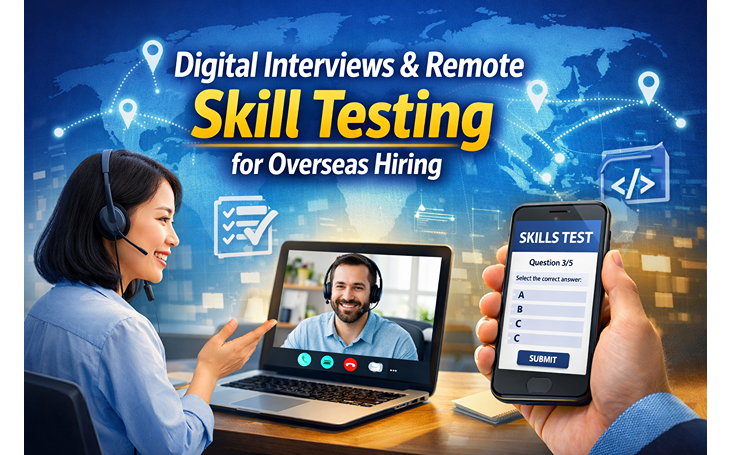
Digital interviews allow employers to interact with candidates without waiting for travel arrangements or organizing large physical interview drives. Through video calls, panel sessions, or recorded interviews, companies can evaluate workers within hours.
This improves hiring in several ways:
◾ Faster shortlisting
◾ Lower cost for employers
◾ Better accessibility for candidates
◾ Quicker decision making
◾ Ability to interview large groups in a single day
For industries where deadlines are strict, such as expo events or construction projects, this speed makes a major difference in meeting schedules.
Remote Skill Testing for Technical Roles
Technical hiring often involves testing practical ability. With digital tools, this can now be done remotely. Candidates perform tasks under supervision while employers observe through video platforms.
Remote skill testing helps evaluate:
◾ Welding techniques
◾ Plumbing and electrical work
◾ Machine operation
◾ Fabrication tasks
◾ Maintenance skills
◾ Basic housekeeping or hospitality duties
This method saves time while still giving employers a clear understanding of a worker’s proficiency.
How Technology Reduces Recruitment Time
Traditional recruitment involved multiple physical steps. Employers arranged trade test centers, scheduled interview drives, and waited for final selections. Technology has replaced these longer cycles with faster online systems.
Digital hiring reduces time by:
◾ Eliminating travel requirements
◾ Enabling same day interviews
◾ Allowing quick re evaluations
◾ Providing instant feedback
◾ Tracking candidate progress digitally
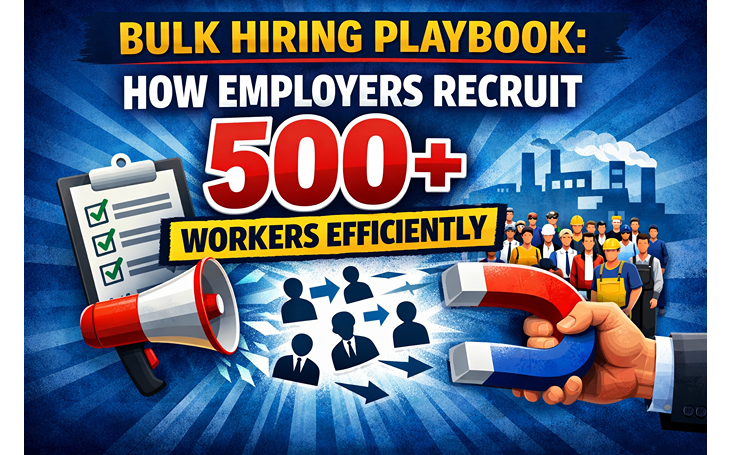
This approach is especially helpful for bulk hiring in factories, oil and gas projects, or large construction sites where many positions must be filled efficiently.
Improved Transparency for Employers and Candidates
Digital platforms create clear communication between all parties. Employers can view candidate profiles, documents, test results, and interview recordings in one place. Candidates can track their status and stay informed about next steps.
This transparency helps:
◾ Reduce misunderstandings
◾ Avoid duplicated testing
◾ Ensure fair assessments
◾ Maintain accurate records
It creates a smoother and more reliable recruitment experience.
Better Candidate Access Across Multiple Locations
India has a large talent pool spread across many states. Digital methods allow candidates from remote locations to participate in interviews without traveling long distances. This expands the available workforce and ensures employers do not miss skilled talent due to location limitations.
Candidates also benefit by saving travel expenses and completing interviews and tests from authorized centers or from home, depending on the role.
Consistency and Quality in Large Scale Recruitment
Major projects depend on consistent hiring standards. Digital testing helps maintain uniform assessment criteria for all candidates, regardless of location. Employers can evaluate every worker using the same scoring method, reducing bias and improving quality.
This uniformity is especially useful for:
◾ Oil and gas shutdown projects
◾ Factory ramp ups
◾ Event staff hiring
◾ Construction mega sites
A consistent digital process ensures that all workers meet required skill levels before deployment.
Building a Future Ready Recruitment Ecosystem
Digital interviews and remote skill tests are shaping the future of overseas hiring. They offer accuracy, speed, and flexibility while maintaining strong verification and assessment standards. Employers can hire faster, recruitment partners can manage large volumes efficiently, and candidates gain a streamlined pathway to global opportunities.
Technology has not replaced personal interaction. It has made overseas recruitment smarter and more accessible for everyone involved. Get more insights on GILS Pvt Ltd.
Check us out on LinkedIn.