Bridging Time Zones and Languages: Operational Lessons for German Companies Employing Indian and Russian Labor
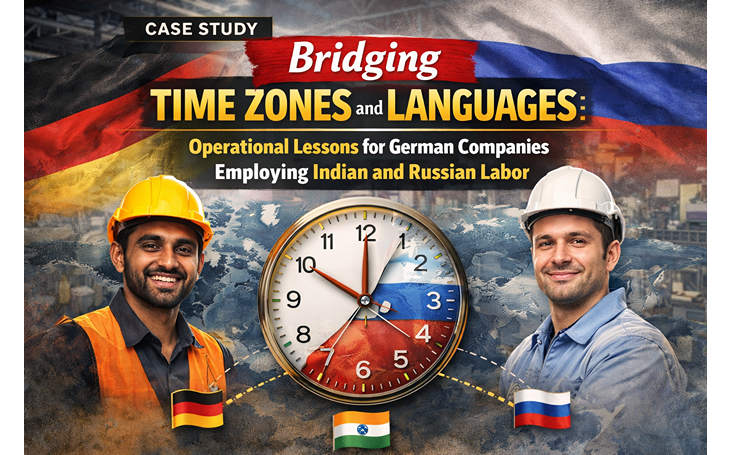
In the era of globalized manufacturing and cross-border collaboration, German companies are increasingly turning to overseas recruitment services to fill critical skill gaps. Whether it is highly skilled welders, CNC operators, or general technicians, international labor, especially from India and Russia, is becoming a cornerstone of Germany’s industrial strength.
However, hiring overseas talent is only the beginning. The true measure of success lies in how effectively organizations manage cross-border teams, particularly when facing operational barriers such as time zones, language differences, and cultural nuances.
This article explores the operational lessons and best practices for German employers who engage Indian and Russian blue-collar workers through overseas recruitment agencies, ensuring not only productivity but also harmony in multinational workplaces.
1. The Global Context: Why Germany Relies on International Labor
Germany’s reputation as Europe’s manufacturing powerhouse rests on its ability to maintain production efficiency while facing demographic challenges. The country’s aging workforce and declining birth rates have created an urgent need for skilled blue-collar workers.
According to recent estimates, Germany requires hundreds of thousands of foreign workers annually to sustain its industrial and infrastructure growth. In this context, international employment services and abroad job consultancy firms have become vital in connecting German employers with reliable manpower from countries like India and Russia.
Indian workers are often recognized for their technical education, adaptability, and English proficiency, while Russian workers bring strong mechanical skills, familiarity with European work practices, and discipline. Together, they form an indispensable part of Germany’s evolving labor force.
2. The Real Challenge Begins After Hiring
Once recruitment is complete, many German employers encounter a new set of challenges, operational, linguistic, and cultural. These include:
◾ Time-zone coordination, especially when managing training, remote support, or cross-facility operations involving teams in different countries.
◾ Language barriers, leading to miscommunication on the shop floor or during safety briefings.
◾ Cultural differences, which can affect teamwork, motivation, and management styles.
◾ Adaptation challenges, such as acclimating workers to German work ethics, documentation standards, and punctuality expectations.
Successfully addressing these challenges determines whether a company’s manpower deployment strategy truly adds value or becomes a costly administrative burden.
3. Lesson 1: Plan for Communication, Not Just Labor
The first operational insight is simple but often overlooked. Hiring skilled labor is not enough; effective communication channels must be built into the workflow from the start.
For example, many Indian workers are comfortable with English, but shop-floor supervisors in Germany may prefer German as the medium of instruction. Russian workers may be fluent in Russian but not English, creating a multi-layered communication structure.
Solutions include:
◾ Providing basic German language training as part of the pre-deployment process through trusted overseas recruitment agencies.
◾ Using translation-assisted training modules and multilingual safety materials.
◾ Designating bilingual team leads or cultural liaisons who can bridge daily communication gaps.
GILS Pvt Ltd integrates basic language familiarization in its pre-deployment orientation programs, ensuring workers arrive with enough communication competence to function effectively from day one.
4. Lesson 2: Synchronize Workflows Across Time Zones
While most Indian and Russian workers deployed to Germany operate locally, there are often coordination needs with offshore teams such as HR support, payroll processing, or remote training teams based in their home countries.
To manage this, German companies should:
◾ Establish fixed communication windows that overlap between Germany, India, and Russia.
◾ Utilize digital workforce management tools such as Slack, Asana, or MS Teams to log updates asynchronously.
◾ Maintain clear shift schedules that respect workers’ rest periods and minimize fatigue from extended communication cycles.
Streamlined time-zone management prevents delays, enhances accountability, and ensures consistent productivity even across borders.
5. Lesson 3: Cultural Intelligence Builds Stronger Teams
Cultural understanding is one of the most undervalued aspects of overseas recruitment. German management styles are often highly structured, emphasizing precision, documentation, and autonomy. In contrast, Indian workers may be accustomed to more hierarchical supervision, while Russian teams tend to value directness and clarity.
Bridging these differences requires cultural intelligence, awareness, sensitivity, and adaptability in leadership.
Practical measures include:
◾ Conducting cultural orientation sessions for both local and foreign staff.
◾ Encouraging cross-cultural mentoring by pairing German supervisors with international workers for mutual learning.
◾ Promoting team-building activities that blend work and social integration.
Companies that invest in this aspect see a marked reduction in attrition and conflict, enhancing the overall success of overseas jobs programs.
6. Lesson 4: Compliance and Documentation Discipline
When managing multi-national blue-collar teams, compliance is non-negotiable. Germany has strict regulations governing manpower deployment, wages, insurance, and worker welfare. Employers must ensure that all documentation, from visas and contracts to wage slips, is transparent and verifiable.
Partnering with reputable overseas recruitment consultants like GILS Pvt Ltd ensures that every deployment meets both German legal standards and international ethical benchmarks.
Beyond compliance, maintaining detailed records of communication, training, and welfare support fosters trust and accountability essential for long-term success.
7. Lesson 5: Leverage Technology for Workforce Integration
Digital platforms have transformed how global workforces operate. From multilingual HR management systems to automated onboarding portals, technology minimizes friction in managing diverse teams.
Examples include:
◾ E-learning modules for ongoing skill development and safety updates.
◾ Mobile HR apps that allow workers to access payroll, schedules, and company policies in their native language.
◾ Digital feedback tools that give workers a voice, enabling early detection of morale or communication issues.
By adopting these tools, German firms can maintain operational consistency while empowering foreign workers to feel connected and informed.
8. Lesson 6: Continuous Feedback and On-Site Support
Successful international employment services extend beyond recruitment. Post-hire engagement, including welfare monitoring and on-site support, ensures smooth assimilation.
Employers should establish:
◾ Regular performance reviews to assess worker adaptation.
◾ On-site welfare officers or cultural coordinators to assist with personal and administrative matters.
◾ Feedback loops with recruitment agencies to refine sourcing and preparation processes.
Such systems not only enhance retention but also position the employer as a responsible global recruiter.
9. The GILS Advantage: Empowering Seamless Cross-Cultural Workforce Deployment
At GILS Pvt Ltd, we understand that bridging borders is not just about moving people, it is about aligning systems, expectations, and human connections. Our comprehensive overseas recruitment services for German industries combine:
◾ Rigorous talent screening.
◾ Pre-deployment training in language and safety.
◾ Compliance management for documentation and contracts.
◾ Continuous post-deployment support for both employers and workers.
Whether your goal is to hire blue-collar workers from India, skilled technicians from Russia, or expand production with international manpower deployment, GILS ensures that operational efficiency and cultural harmony go hand in hand.
10. Conclusion
As globalization reshapes the labor market, the ability to bridge time zones, languages, and cultures has become a defining factor in recruitment success. For German companies employing Indian or Russian labor, operational excellence goes beyond hiring. It is about integration, empathy, and long-term partnership.
With the right balance of technology, training, and transparent communication, international teams can achieve extraordinary synergy, driving innovation, productivity, and mutual growth.
At GILS Pvt Ltd, we are proud to lead this transformation through ethical, effective, and future-ready overseas recruitment solutions.
Check us out on LinkedIn.